How to choose the right markets for international spirits expansion
Markets
Expansion

Why the biggest market isn’t always the best market for your brand.
Expanding internationally is an exciting step for any spirits brand. New consumers, new partnerships and opportunities to build a business beyond your home market.
But deciding where to expand isn’t always straightforward.
The United States offers enormous potential, Germany is one of Europe’s established spirits markets, and the UK has an influential cocktail culture. Meanwhile, markets across Asia are developing their own appetite for international spirits brands.
There are plenty of opportunities. The challenge is identifying which ones make sense for your brand.
Too often, international expansion starts with a distributor showing interest, an introduction at a trade fair or simply the ambition to enter a large market. There’s nothing wrong with any of these, but they shouldn’t determine your international strategy.
At Russell & Stellar, we believe market selection should start with understanding where your brand has the best chance of building a sustainable business. That means looking beyond market size and considering consumer demand, competition, pricing, distribution and the investment required to succeed.
Here are six things we believe every spirits brand should consider when deciding which international markets to enter.
1. Start with your brand
Before looking at countries, it’s worth taking a closer look at your own brand.
What makes it different? Who is your target consumer? What drinking occasions does it fit? And how does it compare with the brands already available in other markets?
A premium tequila, an emerging whisky and a non-alcoholic aperitif may all have international ambitions, but their opportunities will look very different.
A brand built around cocktail culture might find its audience in markets with a strong on-trade scene. A premium whisky with an interesting provenance story could be better suited to markets with established specialist retailers and whisky enthusiasts.
At Russell & Stellar, we use our Bold Brand methodology to evaluate what makes a brand distinctive, from positioning and storytelling to product, design, pricing and the occasions it can own.
This provides a useful starting point for identifying markets where the brand is likely to resonate. After all, a market can have strong spirits consumption without necessarily being a good market for your particular brand.
2. Look beyond market size
Market size is often one of the first things brands consider when evaluating international opportunities. And understandably so. Larger markets generally offer a bigger potential consumer base.
But they can also mean intense competition, established consumer preferences and significant investment to gain visibility. A smaller market might offer less overall volume but better opportunities for a distinctive new brand.
When evaluating a market, we look at several factors:
Category development. How is your category performing? Is it growing, declining or changing? And what’s happening within the premium segment?
Consumer behaviour. Are consumers open to discovering new brands? Which drinking occasions and channels are driving demand?
Competition. Which brands dominate the category? How are they positioned and priced? Is there room for something different?
Market trends. Are there broader developments that could support your brand, such as premiumisation, cocktail culture or growing interest in emerging spirits categories?
For example, a relatively small market with a developing premium rum category might offer more interesting opportunities for a new rum brand than a much larger market already dominated by established competitors.
The important thing is to understand not just how big a market is, but how attractive it is for your brand.
3. Make sure the pricing works
One of the most important parts of market selection is also one of the most frequently underestimated: pricing.
A brand may have a strong proposition and an attractive target market, but if the pricing doesn’t work, building a sustainable business becomes difficult.
Import duties, excise taxes, logistics costs, distributor margins and retail margins all influence the final consumer price. A bottle retailing at €35 in one country could end up considerably more expensive in another, potentially moving it into a completely different competitive set.
Before entering a market, it’s therefore important to build a realistic price structure, starting with your ex-works (EXW) price and working through the full value chain to the expected retail price.
Can the brand compete at the resulting consumer price? Can the distributor and retailer earn healthy margins? Is there enough room to invest in marketing and activation? And does the brand owner still make an attractive return?
At Russell & Stellar, pricing and value-chain analysis are an important part of our market evaluation. The right pricing structure should work for everyone involved. Otherwise, even an attractive market can become difficult to develop.
4. Understand the distribution landscape
Consumer demand is important, but brands also need a realistic route to market. And distribution works very differently from one country to another.
Some markets have a large number of independent spirits importers and distributors. Others are dominated by a relatively small group of established players. In countries such as Sweden, Norway and Finland, government-controlled retail systems add another layer of complexity.
These differences affect how brands enter a market, which channels they can access and how much investment may be required.
But understanding the distribution structure is only the beginning. Finding the right distributor is often more important than finding the biggest one.
A distributor might have excellent coverage but limited interest in adding another brand to an already crowded portfolio. A smaller, more specialised distributor could offer greater attention, stronger category knowledge and better access to the right customers.
This is why we consider distributor availability and suitability as part of market prioritisation, rather than something to address after selecting a country.
Through our Curious Distributor Database, covering more than 2,500 distributors across 80+ markets, and our international network, we can identify potential partners and evaluate how well they fit a particular brand.
A market with good consumer potential but no suitable distribution partner may not be the right place to start.
5. Look one or two layers deeper
Once you’ve identified a number of potentially attractive markets, the next step is understanding which ones offer the best opportunities for your particular brand.
This is where we believe it’s important to look beyond the obvious.
Market size and category growth are useful starting points, but they rarely tell the full story. You also want to understand local consumer preferences, how open consumers are to new brands and categories, what they’re willing to pay for premium products and where opportunities exist within the competitive landscape.
At Russell & Stellar, we use market intelligence and bubble charts to bring these different perspectives together.
Rather than applying the same criteria to every brand, we select the indicators that are most relevant to its category, positioning and target consumer.
Depending on the brand, these might include:
Consumer openness: How receptive is the market to new brands, emerging categories or less traditional spirits?
Premium potential: What are consumers willing to pay, and how developed is the relevant premium segment?
Category dynamics: How is the category developing, and where are the opportunities for growth?
Market potential: What is the relative size of the relevant category or consumer segment?
By combining these indicators, we can identify groups of markets with similar characteristics and get a clearer picture of where the most interesting opportunities might be.
The approach is deliberately flexible. The factors that make one market attractive for a premium rum brand may be very different from those that matter for a tequila, gin or non-alcoholic aperitif.
The objective isn’t simply to rank countries by size or growth. It’s to understand where the underlying market dynamics best match the brand’s proposition and ambitions.
Of course, the analysis doesn’t stop there. Pricing, distribution opportunities, local market knowledge and available resources all play an important role in determining which markets to prioritise.
Ultimately, it’s about looking one or two layers deeper to make better-informed decisions about where to focus your international expansion.
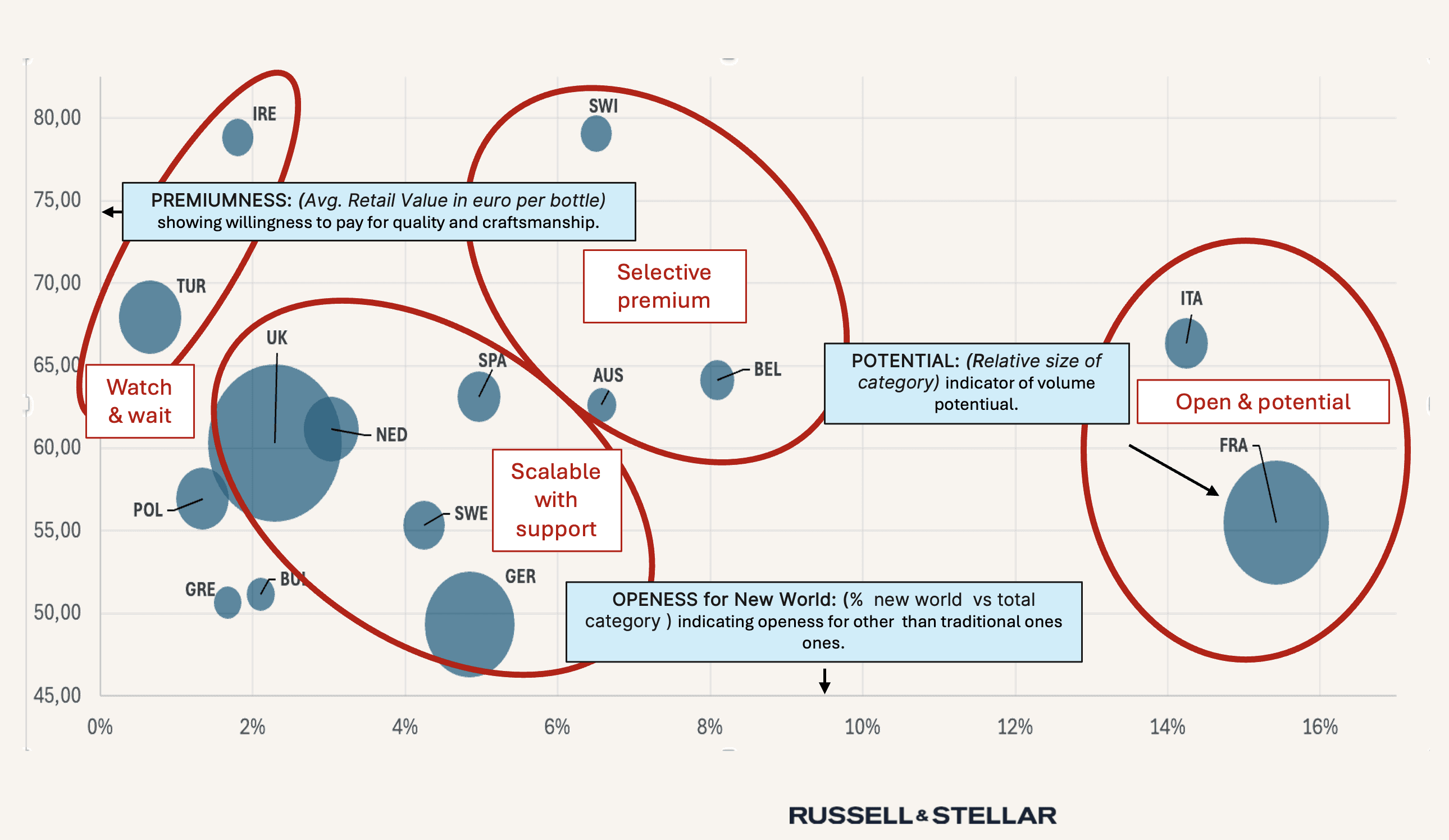
The Russell & Stellar approach: looking beyond market size to identify opportunities based on consumer behaviour, category dynamics and premium potential.
6. Turn insights into an expansion plan
Selecting the right markets is an important first step, but brands also need to decide how to enter them, which partners to work with and what resources they can commit.
For a smaller brand, establishing a strong position in two or three carefully selected markets may create a better foundation for future growth than spreading resources across ten. The right number will depend on the brand’s ambitions, budget and capabilities.
At Russell & Stellar, we combine market intelligence with practical international spirits experience to help brands make these decisions.
Through R&S Compass, we support strategic decisions around positioning, pricing, market prioritisation and international growth. Our AI-powered market intelligence tools help us analyse opportunities across more than 80 spirits markets.
Through R&S Crew, we help put those decisions into practice, from identifying best-fit distributors and developing market-entry plans to supporting partnerships and commercial development.
Having worked with brand owners and distributors across different markets, we know that understanding a market on paper is one thing. Knowing what it takes to build a business there is another.
The Russell & Stellar perspective
Having worked on both sides of the table, with brand owners and distributors, we’ve seen how differently international expansion can play out.
Some brands build successful businesses in markets that weren’t initially on their radar. Others struggle in countries that looked like obvious opportunities on paper.
In our experience, the difference often comes down to doing the homework, finding the right local partners and being realistic about the investment required.
That’s why we believe the right market intelligence and local expertise can help brands make smarter decisions, move faster and focus their efforts where the opportunities are greatest.
After all, international expansion shouldn’t be about adding countries to a distribution map. It should be about building a business that lasts.
Frequently asked questions about international spirits expansion
How do you choose the best international markets for a spirits brand?
Start by evaluating category dynamics, consumer demand, competitive positioning, pricing and distribution opportunities. Market size alone isn’t enough. The most attractive markets are those where consumer preferences, commercial conditions and your brand’s positioning align.
Which countries are best for exporting premium spirits?
There is no single best market for every spirits brand. Large markets such as the United States, Germany and the United Kingdom offer significant opportunities, but smaller markets can be equally attractive depending on the category, consumer preferences, price positioning and availability of suitable distribution partners.
What factors should spirits brands consider before entering a new market?
Key considerations include category size and growth, consumer trends, competition, import regulations, excise duties, retail pricing, distributor availability and the investment required to launch and develop the brand.
How many international markets should a spirits brand enter at once?
For brands with limited resources, focusing on two or three carefully selected markets can be more effective than launching across many countries simultaneously. The ideal number depends on the brand’s budget, organisational capabilities and existing international presence.
How can AI help with international spirits market selection?
AI-powered market intelligence can help brands analyse and compare category trends, consumer behaviour, competition, pricing and market structures across countries. However, reliable data, industry experience and local market knowledge remain essential for validating opportunities and making informed decisions.
Ready to explore your next market?
Whether you’re considering your first international launch or reviewing your existing export strategy, choosing the right markets is one of the most important decisions you’ll make.
At Russell & Stellar, we help bold spirits brands identify the right opportunities, connect with the right partners and build sustainable international growth.
Curious where your brand could thrive next? Let’s explore together.


